A sustainable future in early childhood education and preschool education
Measures aimed at a sustainable lifestyle and a sustainable future are underpinned by various international and national strategies and commitments, as well as strategies specific to local authorities. The Municipalities Act sets out the municipalities’ responsibilities for promoting sustainable development. According to this, a municipality must strive to promote not only the well-being of its residents but also the sustainable development of its area. Municipalities’ work on sustainable development is guided by Finland’s sustainable development strategy as well as international strategies and commitments.
Concepts and issues relating to a sustainable future are strongly emphasised in both the national core curriculum for early childhood education and care and the national core curriculum for pre-primary education. A sustainable lifestyle is one of the core values underpinning early childhood education and care and is therefore a natural part of the operating culture.
Sustainable development can be divided into four areas: the ecological, economic, social and cultural dimensions.
Socially sustainable practice in early childhood education and care and pre-primary education is based on the principles of equality, non-discrimination, valuing diversity, gender sensitivity and anti-racism. In practice, this is reflected, amongst other things, in the development of emotional and social skills and the prevention of bullying.
Cultural sustainability in early childhood education and care and pre-primary education is based on an appreciation of languages, cultures and world views, as well as the preservation of cultural heritage. In practice, this is reflected, amongst other things, in language- and culture-aware activities, education in different world views, and learning about one’s own and other cultures.
Ecological sustainability in early childhood education and care and pre-primary education is based on respect for nature, an appreciation of biodiversity and environmentally responsible practices. Through these activities, children learn about natural phenomena and develop a better understanding of sustainable choices and their significance for the environment. In practice, this is reflected, amongst other things, in environmental education, the promotion of sustainable eating, energy saving, recycling, practising moderation, and fostering children’s optimism and belief in the future.
In early childhood education and care and pre-primary education,economic sustainability is based on moderation, the responsible use of resources and long-term thinking. Our activities reinforce children’s understanding of the importance of sustainable choices and of valuing shared resources. In practice, this is reflected, for example, in the shared use of premises, frugality, a life-cycle approach, repair and reuse, and making wise choices in everyday life.
A Sustainable Future in Tampere’s Early Childhood Education and Care and Pre-primary Education – A Guide
This guide has been compiled to support the teaching of a sustainable lifestyle in Tampere’s early childhood education and care units and pre-primary education units. The purpose of the guide is to link the City of Tampere’s early childhood education and care plan and pre-primary education plan to the day-to-day sustainability work carried out in early childhood education and care and pre-primary education.
The guide is aimed at staff in early childhood education and care and pre-primary education, as well as anyone interested in the subject.
Forest Prescription
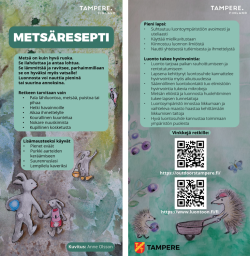
A ‘Forest Recipe’ has been developed for early childhood education and care and pre-primary education in Tampere. The guide encourages families to enjoy nature together. You don’t need to go far into the forest to spend time in nature; enjoyable experiences can also be had in your own garden or a nearby park.
The ‘Forest Recipe’ explains the positive effects of nature on wellbeing and offers practical tips and links to support families’ shared outings.